
Introduction
In modern factories, automation relies heavily on accurate sensing systems. Whether it's tracking the position of a moving part, controlling robotic motion, or monitoring equipment status, magnets play a core role in making these functions reliable and repeatable.
As an automation magnet supplier, HiMagnet supports manufacturers who need stable, high-precision magnetic components for sensors and intelligent machinery.
Why Magnets Are Essential in Industrial Automation
Magnetic sensors are widely used because they are:
- Non-contact, reducing mechanical wear
- Resistant to dust, oil, and vibration
- Stable over long operating cycles
- Compatible with harsh industrial environments
For smart factories pursuing higher uptime and faster production, these advantages make magnetic solutions more practical than optical or mechanical sensing systems.
Key Applications of Sensor Magnets in Automation
1. Position Detection Systems
Magnets are commonly paired with Hall sensors or magnetoresistive sensors to detect movement or part positioning.
Examples include:
- Robotic arm rotation feedback
- Conveyor belt positioning
- Safety doors and machine guards
- Pneumatic cylinder position sensing
In these systems, the magnet must provide a stable and predictable field to ensure consistent readings.
2. Linear Displacement Measurement
Many automation machines require accurate linear feedback without physical contact.
Magnet-based systems enable:
- Precise measurement of slider or rod position
- Long-distance sensing without signal loss
- High resistance to dirt, dust, and oil
For example, linear magnetic encoders rely on specially magnetized strips or multi-pole magnets to generate consistent signals along the measurement path.
3. Smart Factory and IIoT Sensors
As factories adopt more connected equipment, magnets support a wide range of intelligent devices, including:
- Predictive maintenance sensors
- Vibration and motion detection modules
- Automated quality inspection systems
- AGV and AMR navigation systems
Magnets enable sensors to operate reliably even in challenging environments where optical sensors struggle.


What Makes a Good Sensor Magnet?
1. Consistent Magnetic Strength
Fluctuation in field intensity can affect sensor accuracy, especially in linear or rotational feedback systems.
2. High Dimensional Precision
Tight tolerances ensure proper alignment with the sensing element.
3. Material Stability
NdFeB magnets are common, but SmCo may be preferred for high-temperature or high-precision applications.
4. Proper Magnetization Pattern
Some automation systems need:
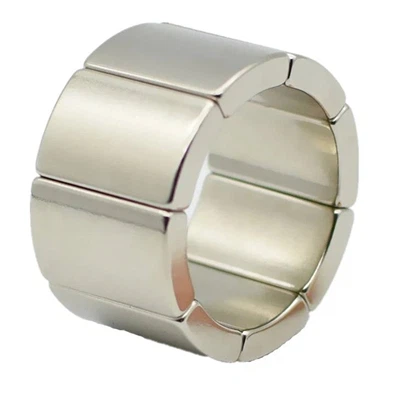
- Radially magnetized rings
- Multi-pole magnets
- Magnetized strips for encoders
This requires controlled magnetization and accurate pole spacing.
5. Reliable Coating
Depending on the machine environment, magnets may require nickel plating, epoxy, or parylene for long-term protection.
How HiMagnet Supports Automation Manufacturers
HiMagnet works with automation equipment makers to provide magnets designed specifically for sensor integration. Our capabilities include:
- Custom-shaped magnets for compact sensors
- Multi-pole magnetization for linear encoders
- High-stability magnets for robotic motion control
- Coating options for oily or high-humidity environments
- Batch consistency for large-scale OEM production
With experience supplying magnets for robotics, CNC machines, packaging systems, and smart factory devices, we deliver components that meet the precision and reliability demanded by industrial automation.
Magnets are a foundational part of modern sensing and automation technology. They enable non-contact detection, stable performance, and long service life in environments where other sensing methods often fail.
As automation continues to expand into every corner of manufacturing, reliable sensor magnets will become even more important for ensuring accuracy and operational efficiency. HiMagnet provides tailored magnetic solutions to help equipment manufacturers build smarter, more reliable systems.


