Suspended magnetic separators (overband magnets) are installed above conveyor belts to remove tramp iron-excavator teeth, broken tool bits, rock bolts-before material enters crushers or mills. A single piece of tramp iron in an impact crusher can cause 50,000−50,000−200,000 in damage plus days of downtime. This guide covers protecting crushers from tramp iron, comparing permanent vs. electromagnetic overbands, providing a data table of power consumption and weight, and calculating optimal suspension height and belt speed.
Protecting Crushers and Shredders from Tramp Iron Damage
Conveyor belts in mining carry 500-5,000 tonnes per hour of ore, coal, or aggregate. Tramp iron (ferrous debris) can be:
Small (<50mm): causes accelerated wear of crusher liners. Each 10mm piece passing through a cone crusher reduces liner life by 1-2%.
Medium (50-200mm): can jam crusher chambers, requiring 4-12 hours of downtime to clear.
Large (>200mm): may fracture crusher main shaft or housing, total loss of equipment.
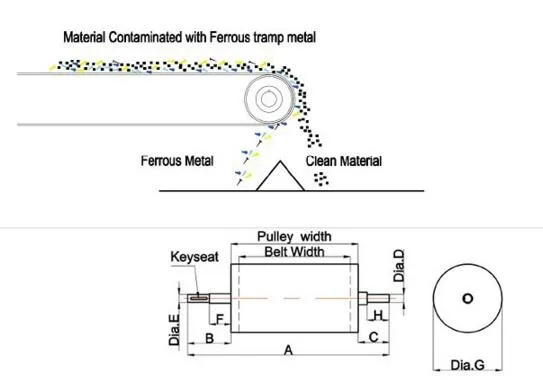
Suspended magnetic separators mounted 200-500mm above the belt surface extract tramp iron continuously. The magnet lifts pieces off the belt and holds them against a moving belt or stationary plate. An automatic discharge system removes tramp iron into a collection bin.
Permanent Magnetic Overbands vs. Electromagnetic Separators
Two types dominate:
Permanent overbands: Use high-grade NdFeB magnets (N45SH or N50) with a steel circuit. No power consumption. Field strength at belt surface: 1,500-3,000 Gauss typically (depending on height). Continuous duty, cannot be turned off. Suitable for applications where tramp iron is moderate and belt speed <2 m/s.
Electromagnetic overbands: Use a DC electromagnet (copper or aluminum coil). Require 2-15 kW of power. Field strength: 2,500-5,000 Gauss at same height. Can be pulsed for higher peak fields. Can be switched off for cleaning or maintenance. Suitable for heavy tramp iron (large excavator teeth, drill bits) and high belt speeds (>2 m/s).
Comparison table: Permanent vs. Electromagnetic suspended separators
| Parameter | Permanent Overband (NdFeB) | Electromagnetic Overband |
|---|---|---|
| Power consumption (kW, typical) | 0 | 5 – 12 (for 1m belt width) |
| Magnetic field at 300mm height (Gauss) | 1,800 – 2,500 | 3,500 – 5,000 |
| Maximum tramp iron piece size | Up to 15kg | Up to 50kg+ |
| Maximum belt speed (m/s) | 2.0 (standard), 2.5 (high-force) | 3.5 |
| Weight (kg for 1m belt width) | 1,200 – 1,800 | 2,000 – 3,500 (including transformer) |
| Temperature sensitivity | NdFeB derates above 80°C; use SmCo for hot ore | Ambient limited by coil insulation (Class F 155°C) |
| Maintenance interval | None (magnetic circuit) | Check terminals, cooling fan annually |
| Relative purchase cost (per unit) | 1.0 (baseline) | 1.8 – 2.5 |
| Typical application | Coal, aggregate, recycling | Iron ore, copper ore, heavy mining |
Calculating the Optimal Suspension Height and Belt Speed
Suspension height (magnet bottom to belt surface) is critical. Too high: reduced magnetic force, tramp iron misses capture. Too low: belt contact risk and material pile-up. Rule of thumb: Height = belt width × 0.2 to 0.3. For 1000mm belt: 200-300mm clearance.
For each installation, we calculate the required magnetic force (F_m) needed to lift tramp iron vertically against belt speed drag and gravity. Simplified formula:
F_m = m × (g + a) + F_drag
where m = tramp iron mass (kg), g = 9.81 m/s², a = vertical acceleration from magnet pull (depends on gradient), F_drag = belt friction.
At belt speed v (m/s), the available capture time when tramp iron passes through the magnetic field zone of length L (m) is t = L / v. For a typical overband with L = 1.2m and v = 2 m/s, t = 0.6 seconds. During this time, the magnet must pull the tramp iron from belt to magnet. Derivative: if tramp iron is heavy or belt is fast, you need a stronger electromagnet or reduce speed.
We provide selection software: input belt width, speed, tramp iron size/distribution, and we output recommended model, height, and predicted capture efficiency (typically 95-99% for correctly sized units).
For applications with belt speeds above 2.5 m/s or tramp iron over 20kg, we recommend an electromagnetic unit with a deep-penetration field and automatic metal detector upstream to trigger increased coil current when large pieces are detected.
For suspended magnetic separators (overband) for mining and conveyor filtration, please visit our Magnetic Separation & Filtration product page on our website. We supply permanent and electromagnetic models for belt widths from 500mm to 2000mm.
To receive a selection chart and budget quote for your conveyor parameters, contact our separation engineering team. We also offer rental units for on-site testing.
Frequently Asked Questions
Q: How do I clean a permanent overband magnet without shutting down the conveyor?
A: Permanent overbands with a self-cleaning belt (the overband's own rubber belt rotates, pulling captured tramp iron sideways into a discharge chute). For manual-cleaning units (stationary plate) you need to stop the conveyor; not recommended for heavy tramp iron.
Q: What happens if the conveyor belt contains magnetic ore (e.g., magnetite)?
A: Standard overband will extract magnetite along with tramp iron, filling the collection bin quickly. Use an electromagnetic unit with a metal detector that activates only upon detection of large ferrous pieces, or use a rare-earth drum separator downstream to recover magnetite.
Q: How often should the magnet performance be tested?
A: Every 6 months. Use a Gauss meter at a fixed point on the magnet face (cold, no tramp iron). If field has dropped >15% from original value, return for remagnetization (for permanent units) or check coil/rectifier (for electromagnetic). We provide a log sheet with each unit.