The Hidden Cost of Multi-Supplier Motor Development
Engineering a custom motor for robotics, UAV propulsion, or industrial automation involves more than selecting a magnet grade or a lamination thickness. It requires coordinating materials, tolerances, and performance targets across multiple suppliers - each optimizing for their own process, not for the finished motor.
When the silicon steel supplier, the magnet manufacturer, the lamination stamping house, and the motor assembly shop operate independently, the result is predictable: tolerance stack-ups, finger-pointing when prototypes underperform, and qualification delays that push programs by months. For development teams working on tight schedules, the coordination overhead of a fragmented supply chain is often larger than the engineering challenge itself.
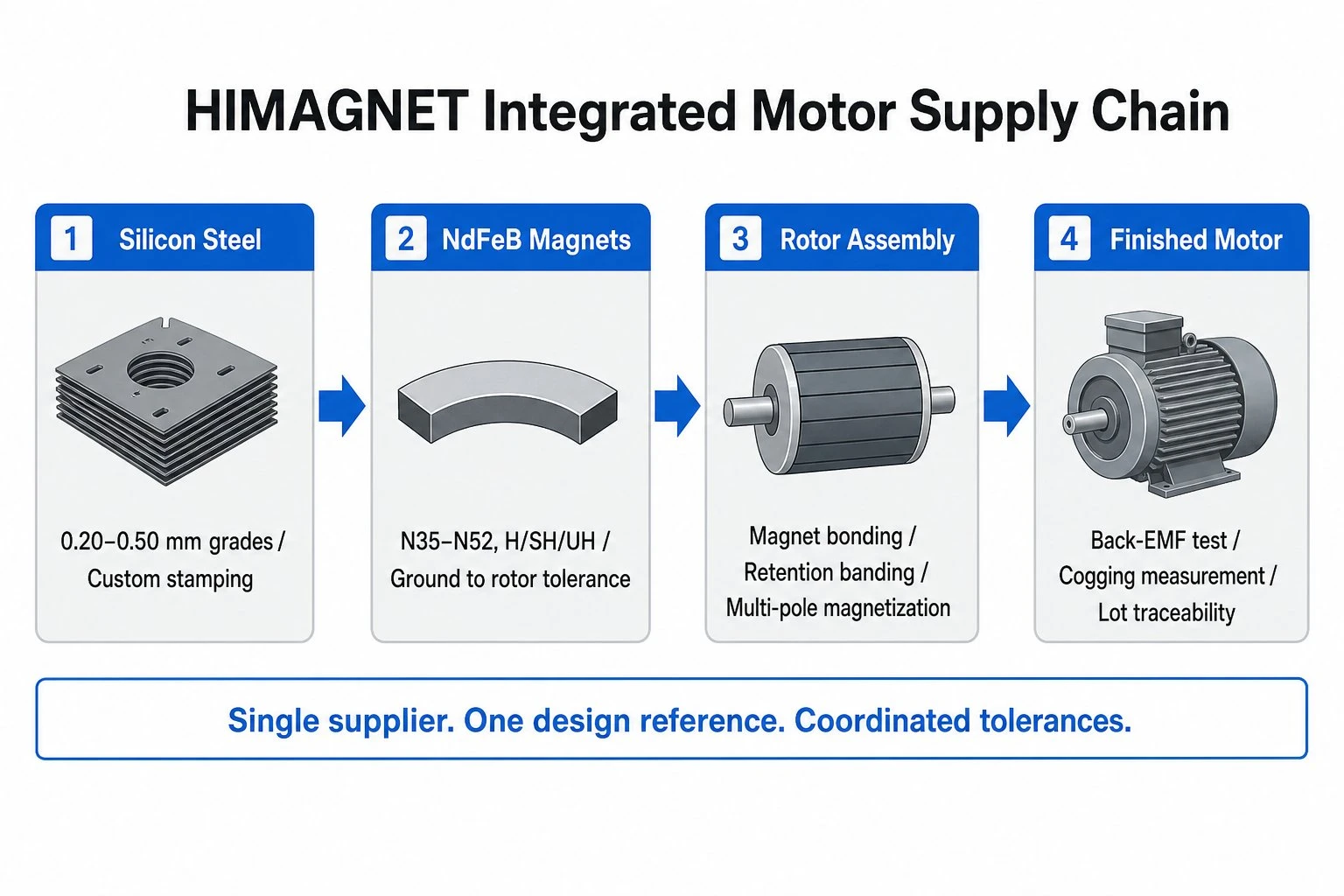
HIMAGNET was built around a different premise: own the technical chain from raw material to finished motor, so the customer deals with one engineering partner instead of four.
The Complete Technology Chain
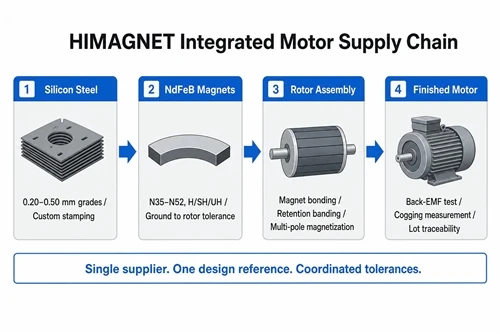
1. Silicon Steel Selection and Lamination Stamping
Every motor design starts with the core material. The choice of silicon steel grade and lamination thickness directly determines iron loss, saturation flux density, and ultimately the motor's efficiency curve.
HIMAGNET sources and processes silicon steel across a wide thickness range - from 0.20 mm ultra-thin grades for high-frequency, high-speed applications (typical in drone motors operating above 20,000 rpm) to 0.50 mm standard grades for industrial servo and torque-dense low-speed designs. The silicon content and grain orientation are selected based on the motor's operating frequency and flux density requirements, not on what happens to be in stock.
Lamination stamping is performed to customer drawings. Stator and rotor laminations are produced as matched sets, ensuring that the air gap geometry, slot geometry, and magnet pocket dimensions are dimensionally consistent with the magnetic circuit design - not independently toleranced by separate suppliers.
2. NdFeB Magnet Manufacturing for Motor Applications
The magnet is not an off-the-shelf component in a custom motor program. Arc segment geometry, magnetization direction, grade, and temperature suffix all need to be specified against the actual rotor design.
HIMAGNET manufactures sintered NdFeB magnets across the full grade range - from N35 to N52 for ambient-temperature applications, and from N35H through N42UH for motors where rotor temperature exceeds 120°C under load. For servo and industrial drive applications, we typically recommend SH or UH suffix grades with measured Hcj verification at operating temperature, not only at 20°C.
Arc segment magnets are ground to tolerance against the actual rotor lamination pocket dimensions from the same program. This eliminates the gap between "magnet print tolerance" and "lamination print tolerance" that causes assembly interference or excessive air gap variation when magnets and laminations come from different suppliers.
3. Rotor Assembly and Magnetization
Magnet installation into a rotor core requires controlled adhesive application, precise angular positioning, and - for surface-mounted configurations at elevated speeds - retention banding. Each of these steps affects the final air gap uniformity, which directly determines torque ripple and back-EMF waveform quality.
HIMAGNET performs rotor magnet assembly in-house, using fixture tooling built against the same lamination geometry used in stamping. Magnetization is performed post-assembly using multi-pole magnetizing fixtures matched to the rotor pole count, producing a consistent sinusoidal flux distribution across the rotor circumference.
4. Motor Integration and Validation
The finished motor - stator winding integrated with the lamination stack, rotor assembly installed, bearings and housing fitted - is tested against the customer's performance specification before shipment.
Standard validation includes no-load back-EMF measurement (to verify magnetization quality and air gap uniformity), cogging torque measurement (to confirm that slot-pole combination and magnet geometry meet specification), and winding resistance and insulation checks. For servo and precision robotics applications, additional tests such as torque constant verification and thermal rise measurement under load are available on request.
Three Application Domains
5. Robotics Joint Actuators
Collaborative robot joints and humanoid robot actuators demand the highest torque density in the smallest package. The magnetic circuit design for these applications prioritizes peak torque per unit volume - which means high-energy NdFeB grades (N45SH to N48SH for typical joint operating temperatures), minimum air gap achieved through tightly toleranced lamination and magnet dimensions, and rotor designs that maximize magnet volume fraction within the allowable rotor diameter.
For IPM (interior permanent magnet) joint motor designs, the magnet pocket geometry in the rotor lamination and the magnet cross-section are co-designed. When both lamination stamping and magnet grinding are performed in the same facility against the same CAD reference, the fit tolerance is held to ±0.03 mm - a standard that is difficult to achieve when laminations and magnets are sourced independently.
6. UAV Propulsion Motors
Drone and UAV motors operate at high rotational speeds (10,000–40,000 rpm for multi-rotor propulsion applications) and require a different optimization than torque-dense servo motors. The priority is power-to-weight ratio and efficiency at cruise power, which means thin laminations (0.20–0.27 mm) to minimize eddy current losses at operating frequency, high-grade surface-mounted arc magnets for maximum air-gap flux, and lightweight rotor construction.
At these speeds, magnet retention is a structural requirement, not just an assembly consideration. Carbon fiber retention banding, applied to the correct pre-stress specification, keeps arc segment magnets on the rotor surface against centrifugal loads while maintaining the designed air gap. HIMAGNET applies retention banding in-house as part of the rotor assembly process.
7. Industrial Servo and Direct-Drive Applications
Industrial servo motors for CNC machine tools, semiconductor handling equipment, and factory automation require consistent performance over long duty cycles and wide temperature ranges. The magnetic circuit must maintain adequate demagnetization margin across the full operating envelope - including fault conditions such as short-circuit current events.
For these applications, HIMAGNET provides B-H curve data at multiple temperatures (typically 20°C, 100°C, and 150°C) with each production lot, allowing the drive and control system to implement temperature-compensated field weakening and demagnetization protection. This data is generated from actual production material, not from grade datasheets.
From Prototype to Production
8. How Custom Programs Work
Custom motor programs at HIMAGNET follow a structured development path designed to compress the timeline between first design intent and validated production parts:
- Design review: Customer shares motor specification (torque, speed, envelope, temperature, duty cycle). HIMAGNET reviews the magnetic circuit design and identifies lamination grade, magnet grade, air gap target, and potential demagnetization risks.
- Prototype build: First article laminations and magnets are produced against customer drawings. Rotor and stator assemblies are built and measured before motor assembly - dimensional verification before electrical testing.
- Performance validation: Back-EMF, cogging, torque constant, and thermal characterization are completed and reported against specification. Design changes - to lamination slot geometry, magnet dimensions, or grade - are iterated within the same supply chain without requalifying a new vendor.
- Production qualification: Production tooling and process controls are established from the validated prototype. First production lot includes full dimensional and magnetic property inspection with traceability documentation.
A Completed Case: Small-Frame Custom Motor for an Industrial Application
In a recent program for an industrial customer (identity withheld by NDA), HIMAGNET delivered a complete custom motor integrating non-oriented silicon steel laminations, ground NdFeB arc segment magnets at N42SH grade, in-house rotor assembly with epoxy bonding and retention, and full motor assembly with performance validation. The program went from design review to validated first articles in eight weeks - a timeline that the customer's previous multi-supplier approach had not been able to achieve in two prior development cycles.
The motor met torque constant specification within 2% and cogging torque within the customer's 5% tolerance on the first prototype build - a result that is difficult to achieve without coordinated control of lamination geometry and magnet geometry in the same facility.
Work With HIMAGNET
If your motor development program involves custom lamination geometry, custom magnet dimensions, or both - and if supply chain coordination has been a bottleneck in previous programs - we are set up to take on the full scope.
Share your motor specification: target torque and speed, rotor diameter, operating temperature range, application environment, and annual volume. We will review the magnetic circuit requirements and respond with a technical assessment and development timeline within two business days.