Pot Magnet vs. Flat Disc Magnet: Which One Fits Your Application
Introduction
Buyers sourcing permanent magnets often default to whichever shape they have used before, without checking whether the magnetic circuit actually fits the application. Pot magnets (also called cup magnets) and flat disc magnets both use the same NdFeB material, but they deliver very different performance per gram because of one structural difference: whether the magnetic circuit is open or closed. This guide compares the two shapes on holding force, mounting method, surface protection, and cost, so you can specify the right one before committing to tooling or a production order.

Structural Difference: Open vs. Closed Magnetic Circuit
A flat disc magnet is a bare magnet. Its flux lines exit the north face, loop through open air, and re-enter the south face - an open magnetic circuit. Much of that flux spreads sideways and backward, where it does no useful work for most mounting applications.
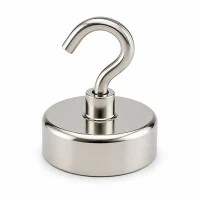
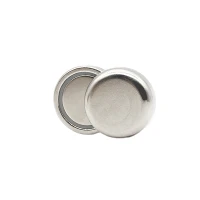
A pot magnet encloses the same disc (or a similarly shaped core) inside a steel cup. The steel housing redirects the flux that would otherwise leak backward and sideways, concentrating it at the open face. This is a closed (or near-closed) magnetic circuit. For the same magnet volume, a pot magnet delivers substantially higher holding force at the working face than a bare disc of the same grade and size, because the steel housing recovers flux that the disc magnet simply loses to the surrounding air.
Comparing the Two in Practice
1. Holding Force per Unit Volume
This is the core reason pot magnets exist. HIMAGNET's D60mm pot magnet (screw-socket type, available in N35 to N52) delivers up to 160kg pull force at that size - a figure that a bare disc magnet of comparable diameter cannot match at the same grade, because the disc has no housing to recover leakage flux. If your application needs maximum holding force in a limited footprint - door catches, workpiece clamping, heavy warehouse mounting - the pot magnet's closed circuit is doing real mechanical work for you.
2. Mounting and Installation
Pot magnets are built for mechanical attachment. HIMAGNET's screw-socket pot magnets mount directly with a bolt through the housing - no adhesive, no welding required for most installations, and welding is available for applications that need a permanent structural joint. Flat disc magnets have no mounting feature of their own; they are typically bonded with adhesive, pressed into a counterbore, or embedded in an assembly. If your design needs a magnet that an installer can bolt on and remove later, the pot magnet's housing is the deciding factor - not the magnet material.
3. Surface Protection and Finish
A bare disc magnet is usually Ni-Cu-Ni coated for corrosion resistance, but the magnet face itself is exposed and can chip on hard contact. A pot magnet's steel housing physically shields the brittle NdFeB core from impact. Rubber-coated pot magnet variants add a non-slip, anti-scratch layer on top of that, which matters when the magnet contacts a finished or delicate surface repeatedly. For disc magnets used in precision assemblies - sensors, locking components, compact motor designs - the ±0.05mm dimensional tolerance that HIMAGNET holds on its N52 disc magnets matters more than surface protection, because the disc is typically housed inside another component rather than exposed.
4. Flux Leakage and Nearby Sensitive Components
Because a pot magnet's housing concentrates flux at the working face and suppresses leakage elsewhere, it is the safer choice near magnetically sensitive equipment, credit cards, or other magnets in a tight layout. A bare disc magnet's open flux field extends in all directions and needs more clearance in multi-magnet assemblies or near electronics.
5. Cost and Material Efficiency
The steel housing adds material and a manufacturing step, so a pot magnet costs more than an equivalent-size bare disc at the same grade. But "equivalent size" is the wrong comparison if your target is a holding force number: a smaller, cheaper pot magnet can often match the pull force of a larger, more expensive disc magnet, because the housing is doing work that would otherwise require a higher grade or larger magnet volume. When force-per-dollar is the metric, run the comparison on delivered holding force, not on raw magnet size.
Decision Table: Which Shape Fits Your Application
If you need maximum holding force in a compact footprint with a bolt-on mounting feature - door catches, fixtures, clamping tools, warehouse mounting - choose a pot magnet.
If you need a magnet embedded inside another component, with tight dimensional tolerance and axial magnetization for a specific circuit layout - sensors, actuators, compact motor stators - choose a flat disc magnet.
If you need surface protection against repeated impact or contact with a finished surface, a rubber-coated pot magnet outperforms a bare disc magnet of any coating.
If your assembly already defines the magnet's housing (your own enclosure, bracket, or stator lamination), a bare disc magnet avoids paying for a second housing you do not need.
How HIMAGNET Supports Pot Magnet and Disc Magnet Selection
HIMAGNET produces both pot magnets (D22 to D88mm, N35 to N52, screw-socket or rubber-coated, with welding processing available) and precision disc magnets (N52 with Ni-Cu-Ni, zinc, black epoxy, or gold coating, ±0.05mm tolerance, axially magnetized) from the same production line, so switching between shapes for a prototype comparison does not mean switching suppliers. Our engineering team can review your target holding force, mounting constraint, and assembly drawing to confirm which shape delivers the result at the lowest total cost.
If you are deciding between a pot magnet and a flat disc magnet for a specific application, send HIMAGNET your target pull force, mounting method, and available space - we will recommend the shape and grade that fits.