Introduction
Once you have decided to use neodymium (NdFeB) magnets, the next engineering decision is which grade to specify. Grades like N35, N42, and N52 represent different maximum energy products - and choosing the wrong one means either overpaying for performance you do not need, or undersizing a magnet that fails to meet your holding force or flux requirements. This guide explains the NdFeB grading system, what the numbers mean in practice, and how to match the right grade to your application.
Understanding the NdFeB Grade System
1. What the Grade Number Means
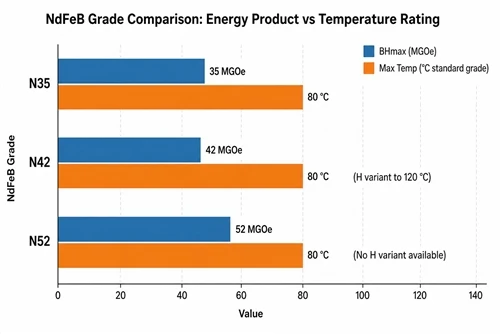
The number in an NdFeB grade designation refers to its maximum energy product (BHmax), measured in Megagauss-Oersteds (MGOe). This is the single most useful figure of merit for comparing magnets: it represents how much magnetic energy is stored per unit volume.
- N35: BHmax = 33–36 MGOe
- N42: BHmax = 40–43 MGOe
- N52: BHmax = 50–53 MGOe - the highest commercially available grade
A higher grade number means more magnetic flux from the same physical volume. Alternatively, for the same required flux output, a higher-grade magnet can be made physically smaller - saving space and weight.
2. The Letter Suffix: Temperature Rating
Grade designations also carry a letter suffix indicating the magnet's maximum operating temperature before irreversible demagnetization occurs:
- N (no suffix, standard): up to 80°C
- M: up to 100°C
- H: up to 120°C
- SH: up to 150°C
- UH: up to 180°C
- EH: up to 200°C
So N42H has the same energy product range as N42, but is rated to 120°C. Adding a higher-temperature suffix typically reduces the maximum achievable BHmax slightly, because the alloy is modified for coercivity rather than energy density.
Grade-by-Grade Comparison
3. N35 - Entry-Level Grade, Cost-Optimized
N35 is the most widely available NdFeB grade and the baseline for cost comparisons. It is appropriate for applications where space is not severely constrained and where the magnet budget is a primary design driver.
- BHmax: 33–36 MGOe
- Remanence (Br): 1.17–1.22 T
- Coercivity (Hcj): ≥955 kA/m (standard N suffix)
- Cost index: lowest among NdFeB grades
- Availability: highest - stocked in most standard shapes and sizes
Best for: door catches, cabinet closures, refrigerator magnets, low-cost consumer products, educational and hobby applications, holding fixtures where size is not critical.
Limitations: for the same holding force or flux requirement, N35 produces a physically larger magnet than N42 or N52. If your design envelope is tight, N35 may not fit.
4. N42 - The Engineering Workhorse
N42 represents the best balance of performance, cost, and availability in the NdFeB family. It is the default specification for most industrial and OEM applications where neither minimum cost nor maximum performance is the overriding constraint.
- BHmax: 40–43 MGOe
- Remanence (Br): 1.28–1.32 T
- Coercivity (Hcj): ≥955 kA/m (standard N suffix)
- Cost index: moderate (approximately 15–25% above N35 at equivalent geometry)
- Availability: high - available in all standard grades including H, SH, UH, EH temperature variants
Best for: motors, actuators, sensors, medical devices, robotics, industrial automation, speaker assemblies, wind turbine generators. N42 is the correct default for any application that does not have a specific reason to go higher or lower.
Limitations: not the right choice where absolute minimum magnet volume is required and cost can flex. For miniaturized designs, N52 should be evaluated.
5. N52 - Maximum Energy, Premium Grade
N52 is the highest-grade NdFeB magnet in commercial production. It delivers approximately 50% more magnetic energy than N35 in the same volume, enabling the smallest possible magnet size for a given performance target.
- BHmax: 50–53 MGOe
- Remanence (Br): 1.42–1.47 T
- Coercivity (Hcj): ≥876 kA/m
- Cost index: highest (approximately 40–70% above N35 at equivalent geometry; price is sensitive to rare earth market)
- Availability: moderate - not all suppliers stock N52 in all shapes; lead times may be longer for custom sizes
Best for: compact electronic devices, wearables, precision instruments, micro-motors, high-end audio components, magnetic couplings where axial length is constrained, aerospace and defense applications.
Limitations: N52 has lower coercivity than N35 or N42 at equivalent temperature ratings. This means it is more susceptible to demagnetization at elevated temperatures or in strong opposing fields. N52 is only available with the standard N temperature rating (80°C max); higher-temperature suffixes (H, SH, UH) are not available at N52 because the alloy modifications required to boost coercivity reduce BHmax below the N52 threshold.
Grade Selection Decision Table
6. Match Your Requirements to the Right Grade
| Requirement | N35 | N42 | N52 |
|---|---|---|---|
| Minimize cost | ✅ Best | ⚠️ Moderate | ❌ Highest |
| Minimize magnet size/volume | ❌ Largest | ⚠️ Moderate | ✅ Smallest |
| Operating temperature >80°C | ⚠️ Add M/H/SH suffix | ✅ Full range available | ❌ 80°C max only |
| Best balance of performance and cost | ⚠️ Lower performance | ✅ Best balance | ⚠️ Diminishing return |
| Strong opposing field / demagnetization risk | ✅ Higher Hcj | ✅ Higher Hcj | ⚠️ Lower Hcj - review |
| Off-the-shelf availability | ✅ Highest | ✅ High | ⚠️ Moderate |
Common Specification Mistakes to Avoid
7. Errors That Lead to Rework or Overspend
- Specifying N52 for a high-temperature application: N52 is only rated to 80°C. Specifying N52 for a motor or sensor that reaches 100°C in service will result in irreversible flux loss. Use N42H or N42SH instead.
- Defaulting to the highest grade "to be safe": N52 has lower coercivity than N42 at the same temperature rating. In assemblies with strong demagnetizing fields (e.g., opposing magnets, high AC fields), N42 or even N35 with a higher coercivity suffix may actually perform more reliably than N52.
- Specifying grade without flux density target: Grade alone does not define magnet performance in an assembly. Circuit geometry, air gap, and back-iron all affect delivered flux. Always validate the grade selection against a target operating point (BH curve, load line intersection).
- Assuming N52 is universally available: For custom shapes and sizes, N52 may require longer lead times or minimum order quantities. For prototype schedules, N42 is the safer default.
Procurement Checklist
8. What to Specify When Ordering NdFeB by Grade
- Grade and temperature suffix: e.g., "N42H" - both the energy product tier and the operating temperature rating. Do not specify grade without suffix if the application exceeds 80°C.
- Magnetic properties at operating temperature: request Br and Hcj values at your maximum operating temperature, not just at 20°C. Suppliers should provide temperature coefficient data (typically −0.12%/°C for Br, −0.6%/°C for Hcj for standard N grades).
- Dimensional tolerances: NdFeB is sintered and ground; standard tolerances are ±0.05 mm for ground dimensions, ±0.1 mm for as-sintered. Specify if tighter tolerances are required.
- Magnetization direction: confirm axial, diametrical, or multi-pole magnetization as required by your assembly. Magnetization direction changes cannot be made after delivery.
- Test certificate (PPAP or material certificate): request a material certificate with measured Br, Hcj, and BHmax for each production lot. For critical applications, request full B-H curve data.
- Coating specification: always pair the grade specification with a coating specification (see our companion guide on NdFeB coating selection). Grade and coating are independent variables but must both be correct for the application.
How HIMAGNET Supports Grade Selection
HIMAGNET manufactures and supplies NdFeB magnets across the full grade range from N35 to N52, including all standard temperature variants (M, H, SH, UH, EH). Our application engineering team can review your design requirements and recommend the most cost-effective grade for your operating conditions.
For motor and actuator designs, we can provide B-H curve data and operating point analysis on request. For volume procurement, we supply test certificates and support PPAP documentation.
Share your application type, required flux or holding force, maximum operating temperature, and geometry constraints - we will recommend the right grade and provide a quotation within one business day.