
Introduction
Modern industrial and technological applications increasingly demand magnets with highly specific magnetic field distributions. From high-resolution encoders to precision motors and robotics, standard magnetization often cannot meet performance requirements. Advanced magnetization techniques, including multipole and custom patterns, allow engineers to design magnets that deliver precise, stable, and efficient performance.
This article explores these techniques, their applications, and considerations for buyers sourcing specialized magnets.
1. What Are Multipole and Custom Magnetization Patterns?
Multipole Magnetization
Multipole magnetization involves dividing the magnet into multiple north-south poles along its surface or circumference. Common configurations include:
- Radial multipole: Poles arranged around a ring for rotary encoders and brushless motors.
- Axial multipole: Alternating poles along the magnet's axis, useful for linear motion sensors.
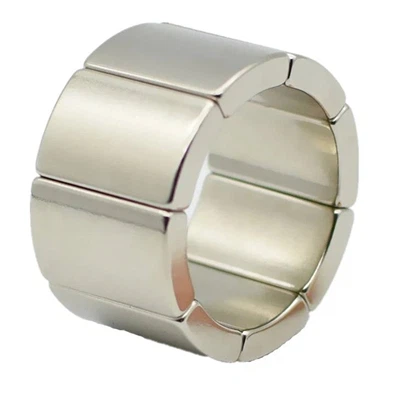
- Segmented multipole: Individual magnet segments magnetized in specific orientations for complex field requirements.
Benefits:
- Improved signal resolution for sensors
- Higher torque density in compact motors
- Reduced cogging and vibration in rotating machines
Custom Patterns
Custom magnetization enables non-standard field distributions to meet specialized application needs. Examples include:
- Linear strips for position sensing
- Alternating patterns for linear actuators
- Partial magnetization to reduce interference with nearby components
Custom patterns are especially useful in robotics, automation, and medical devices, where precise control of magnetic fields is critical.
2. Applications of Advanced Magnetization
High-Resolution Encoders
Multipole magnets paired with Hall-effect or magnetic sensors provide accurate rotational or linear position feedback. This is critical for CNC machines, robotics, and precision industrial automation.
Brushless Motors and Actuators
Multipole magnet configurations improve torque density, reduce cogging, and enhance efficiency in motors of all sizes, from micro motors to large EV traction motors.
Linear Motion Systems
Custom-magnetized strips enable precise linear displacement measurement, helping achieve smoother motion in assembly lines, packaging equipment, and laboratory instruments.
Robotics and Automation
Segmented and multi-pole designs allow robots to achieve high accuracy, reduce vibration, and minimize electromagnetic interference in sensitive environments.


3. Manufacturing Considerations
Producing multipole or custom-pattern magnets requires specialized capabilities:
- Precision magnetizing fixtures to generate accurate pole orientations
- Flux measurement and verification to ensure consistency across batches
- Advanced quality control to prevent misalignment or field distortion
- Material selection: NdFeB for high flux density, SmCo for high-temperature or corrosive environments
Experienced suppliers can provide engineering support for design, prototyping, and scaling production while ensuring consistent magnetic performance.
4. Why Buyers Should Care
- Accurate magnetic field design improves product performance, efficiency, and longevity.
- Customized magnetization can reduce system size, weight, and cost by optimizing the magnetic circuit.
- Working with a knowledgeable magnet supplier ensures feasibility, reliability, and repeatability for advanced applications.
Choosing the right magnetization approach can differentiate products in high-tech markets like robotics, aerospace, medical devices, and electric vehicles.
Multipole and custom magnetization patterns are transforming how magnets are used in precision applications. By leveraging advanced magnetization techniques, engineers can design compact, efficient, and high-performing systems that meet exacting industrial requirements.
Partnering with an experienced supplier capable of custom magnetization ensures consistent quality, innovative solutions, and optimized performance for demanding applications.