Introduction
The rise of Industry 4.0 and the Industrial Internet of Things (IIoT) is transforming manufacturing worldwide. Smart factories rely on precise sensors, compact actuators, and automated equipment to achieve higher efficiency, accuracy, and flexibility. At the core of many of these systems are automation magnets and sensor magnets, which play a critical role in enabling reliable motion control, position detection, and energy-efficient operation.
This article explores how magnets are applied in smart factories and highlights trends in customized magnetic solutions for industrial automation.
1. The Role of Magnets in Industry 4.0
Magnets are essential components in modern automated systems:
- Position Sensing: Hall-effect sensors paired with magnets provide precise feedback for robotic arms, conveyor systems, and linear actuators.
- Actuation: Compact motors and solenoids use magnets for torque generation and movement control.
- Energy Efficiency: High-quality magnets reduce energy losses in motors, leading to lower operational costs.
Reliable magnetic performance ensures that smart factories maintain production accuracy and uptime.
2. Magnet Materials for Industrial Automation
NdFeB Magnets
- High energy density supports compact actuator designs.
- Suitable for sensors, linear motors, and robotic joints.
- High-performance grades maintain stability in varying thermal conditions common in factories.
SmCo Magnets
- Excellent thermal and corrosion resistance for environments with high heat or chemical exposure.
- Used in specialized actuators and precision equipment.
Ferrite Magnets
- Cost-effective for applications with moderate performance requirements.
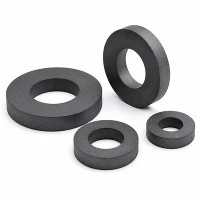
- Often used in large-scale linear motors, conveyor drives, and general automation equipment.


3. Applications in Smart Factories
Robotics and Automated Machinery
- Multipole and custom magnet arrangements enable precise torque and position control.
- Magnets integrated into robotic joints and linear actuators improve repeatability and reduce mechanical wear.
Linear and Rotary Motion Systems
- High-resolution sensor magnets support accurate linear displacement and rotational positioning.
- Magnetic encoders combined with automation magnets improve motion feedback and synchronization.
IoT-Enabled Equipment
- Sensors with micro magnets allow real-time monitoring of machine status and predictive maintenance.
- Compact magnets support miniaturized sensors without sacrificing performance.
Customized Magnetic Solutions
- Smart factories increasingly require magnets with tailored shapes, sizes, and magnetization patterns.
- Customized magnets optimize space, reduce vibration, and meet specific industrial performance criteria.
4. Design Considerations for Automation Magnets
When selecting magnets for Industry 4.0 systems, manufacturers should consider:
- Magnetic field strength and uniformity to ensure accurate sensor readings
- Temperature and corrosion resistance for harsh factory conditions
- Size and geometry to fit compact, space-constrained designs
- Custom magnetization patterns for multi-pole or specialized applications
- Supplier expertise in automation-grade magnets and quality control
A knowledgeable supplier can provide guidance on optimal material selection, magnetization techniques, and protective coatings.
5. Benefits of Using High-Quality Automation Magnets
- Improved precision and repeatability of automated processes
- Reduced energy consumption and operational costs
- Extended lifespan of motors, sensors, and actuators
- Enhanced safety and reliability for critical manufacturing systems
- Flexibility to integrate into customized or modular automation solutions
Magnets are fundamental to the functionality and efficiency of smart factories. From sensor magnets enabling precise position feedback to automation magnets powering compact actuators, the right magnetic solutions enhance productivity, accuracy, and energy efficiency.
As Industry 4.0 continues to evolve, customized magnetic solutions will play an increasingly important role, making it essential to work with experienced suppliers who understand the unique requirements of modern industrial automation.