
Sintered Neodymium magnets face serious electrochemical corrosion and thus various kinds of anti-corrosion technologies have applied to isolate magnet base and environmental substances. Magnet base itself should be strong enough even surface treatment is indispensable to Neodymium magnets. There are two methods to test corrosion rate: the one is the weight increase method, and another one is the weight loss method, then the concept of low weight loss Neodymium magnets emerged. Actually, the essence of low weight loss Neodymium magnets is the high corrosion resistance Neodymium magnets.
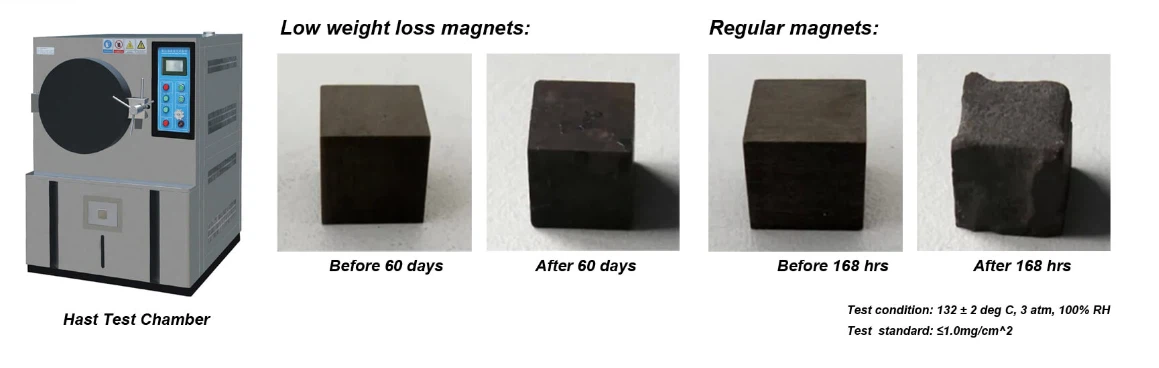
The poor corrosion resistance of Neodymium magnets originate from the following reasons:
Material structure. Sintered Neodymium magnets have multi-phase structure, and different phase has different antioxidant ability. The Nd-rich phase and B-rich phase will be oxidized at first, then formed intergranular corrosion.
Impurities in alloy, especially chloride, will accelerate the oxidation process of Neodymium
Working conditions.
The source power of intergranular corrosion stem from the potential difference between the main phase and Nd-rich phase or the B-rich phase. Hence, minimize potential difference between grain boundary phases can avoid or decrease the intergranular corrosion.
With the in-depth coercivity mechanism research of sintered Neodymium magnets, dual-alloy technology, dual-main phase technology and grain boundary diffusion technology has been introduced to the manufacture process of sintered Neodymium magnets which allowed magnet manufacturers adding new phase during powder making or molding process, include sub-alloy, nano-metal/alloy and micron-size oxide. There is a close correlation between high-coercivity Neodymium magnets and low weight loss Neodymium magnets that both of them are emphasizing the enhancement of microstructure, or optimize the relationship between the main phase and impurity phases.