Preventing Tire Punctures and Equipment Damage in Loading Zones
In a typical metal fabrication or recycling facility, each forklift travels 10-20 km per day over floors contaminated with ferrous debris. A single nail or sharp metal shard can penetrate a solid rubber or pneumatic forklift tire, causing a flat that stops operations for 30-60 minutes. The cost: lost production + tire replacement. For a fleet of 10 forklifts, one puncture per week costs $15,000-$25,000 annually in tire replacements and downtime.
Magnetic sweepers reduce puncture incidents by 80-90%. A 1.5m wide forklift-mounted sweeper with 8,000 Gauss surface field collects debris from the full drive path in a single pass. The captured debris is held until the sweeper is raised and the release mechanism is actuated.
Forklift-Mounted Sweepers vs. Push-Type Magnetic Brooms
Forklift-mounted sweepers: Attach to forklift forks or carriage plates, covering 1.2-2.0m width. The sweeper rides just above the floor (5-15mm clearance). The operator drives the forklift normally; the sweeper collects debris in the travel path. Capacity: up to 50kg of debris before requiring release. Recommended for warehouses >5,000m², scrap yards, and recycling facilities. Price: $1,200-$3,500.
Push-type magnetic brooms: Manual units with wheels and a handle. The operator walks behind, pushing the broom over the floor. Width: 0.3-1.0m. Suitable for tight aisles, docks, and areas where forklifts cannot access. Capacity: 5-15kg. Price: $200-$800.
| Parameter | Forklift-Mounted Sweeper | Push-Type Magnetic Broom |
|---|---|---|
| Sweeping width (m) | 1.2-2.0 | 0.3-1.0 |
| Floor clearance (mm) | 5-15 (adjustable) | 5-10 (fixed) |
| Debris capacity (kg) | 30-80 | 5-20 |
| Cleaning area per hour (m²) | 5,000-15,000 | 300-1,000 |
| Magnet grade used | N42-N50, 8,000-12,000 Gs | N42-N45, 6,000-10,000 Gs |
| Terrain suitability | Flat, smooth floors | Flat, uneven floors (with wheel suspension) |
| Initial cost | $1,200-$3,500 | $200-$800 |

Release Mechanisms for Safe Debris Disposal
When the sweeper's magnetic tubes are saturated with debris, the captured metal must be released safely without the operator touching sharp objects. Two release mechanisms:
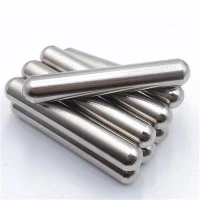
Retractable tube design: The magnetic tubes are mounted on a frame that can be raised (by a handle or hydraulic cylinder). When raised, the magnetic field moves away from the debris collection plate, and the debris drops into a bin. This is standard on forklift-mounted sweepers. The operator drives to a waste bin, actuates the hydraulic or manual release, and the debris falls out in seconds. No physical contact.
Swing-away or flip-over design: Used on push-type brooms. The magnetic bar housing is flipped over by the handle. The debris releases into a tray or directly onto the floor (then swept into a bin). Some models include a plastic scraper that wipes debris from the magnet surface.
For safety, all release mechanisms should be operable without the operator kneeling or reaching under the sweeper. Push-type brooms should have a foot-operated release.
Determining the Right Gauss Rating for Deep Terrain Sweeping
Terrain type determines the required magnet strength and clearance:
| Terrain Type | Debris Type | Recommended Gauss (at tube surface) | Clearance from floor | Notes |
|---|---|---|---|---|
| Smooth concrete warehouse | Nails, bolts, small shavings | 6,000-8,000 Gs | 5-8mm | Standard sweepers sufficient |
| Rough concrete or asphalt | Larger nuts, welding slag | 8,000-12,000 Gs | 10-15mm | Higher clearance requires higher Gauss to maintain field strength at floor level |
| Gravel or outdoor yard | Mixed debris, large chunks | 10,000-12,000 Gs | 15-20mm | Use heavy-duty model with N50 magnets and robust frame |
| Scrap metal yard (high density) | Mixed ferrous scrap | 12,000+ Gs (NdFeB N52) | 10-15mm | Use electromagnet sweepers if debris weight exceeds 100kg |
Rule of thumb: Gauss at the floor surface = Gauss at tube surface × (tube radius / (tube radius + clearance))². For a 30mm diameter tube with 10,000 Gs at surface and 10mm clearance, the field at floor level is approximately 10,000 × (15/25)² = 3,600 Gs. This is sufficient for 1-5kg debris but not for heavy chunks. For deeper terrain, increase tube diameter or lower clearance.
For magnetic sweepers – forklift-mounted and push-type models, including spare magnetic tubes for replacement – please refer to our Magnetic Solutions and Magnetic Workholding & Lifting pages on our website.
To select the correct sweeper width and gauss rating for your facility, please send us your floor area, typical debris type (size and weight), and whether you prefer a forklift-mounted or push-type unit. Our material handling team provides a free site assessment.
Frequently Asked Questions
Q: How often should we clean/empty the magnetic sweeper during daily use?
A: For forklift-mounted sweepers, empty when debris reaches 70% of capacity (roughly every 2-4 hours of sweeping). Continuing beyond capacity causes debris to spill back onto the floor. For push-type, empty when the magnet surface is visibly covered (every 15-30 minutes).
Q: Can magnetic sweepers collect stainless steel or aluminum debris?
A: No. Only ferrous (iron, steel, nickel, cobalt) is magnetic. Stainless steel 304/316 is non-magnetic and will not be collected. Aluminum, copper, brass, and plastic are also not collected. For mixed debris, use a vacuum sweeper with a magnetic separator on the discharge.
Q: Do magnetic sweepers lose strength if they are dropped or impacted?
A: Neodymium magnets are brittle. Dropping the sweeper from >0.5m or hitting a concrete curb can cause magnet cracking, resulting in permanent strength loss (10-50%). Always lift and lower sweepers gently. We offer replacement magnet cartridges.