
Rated Lifting Capacity vs. Maximum Breakaway Force
Rated capacity is the safe working load (SWL) that the lifter can reliably handle under normal conditions, with a safety factor of 3:1 to 5:1 (i.e., breakaway force is 3-5x rated capacity). For a 1000kg rated lifter, breakaway force is typically 3000-5000kg. This margin ensures that even if the load shifts or the operator accelerates the crane, the magnet does not release.
Only use magnetic lifters with a mechanical safety latch (e.g., a spring-loaded hook or secondary lock). Even with the magnet turned off, the latch prevents the load from falling if the operator accidentally hits the release button. Industrial standards: ASME B30.20 (below-the-hook lifting devices) and EN 13155 (cranes – lifting magnets).
For new lifters, we provide proof load test certificates showing a test load of 1.25x rated capacity applied for 5 minutes with no permanent adhesion loss.
How Surface Roughness and Air Gaps Reduce Magnetic Pull
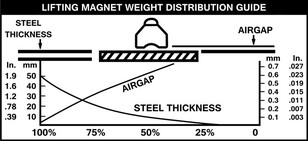
Surface roughness and air gaps dramatically reduce magnetic pull because magnetic force decays approximately with the square of distance. A 0.2mm air gap (e.g., from paint, rust, or mill scale) reduces pull force by 20-30% compared to a clean flat surface. A 1mm air gap reduces pull by 50-70%. Therefore, for lifting plates with heavy rust or thick coating (e.g., 0.5mm epoxy paint), derate the lifter capacity by 40-50%.
For rough surfaces (Ra > 25μm) or corrugated plates, use a magnetic lifter with articulated or rubber-faced poles that conform to the surface. Standard rigid pole lifters are suitable only for ground or machined surfaces (Ra < 6μm).
Typical derating factors:
| Surface Condition | Air Gap (mm) | Derating Factor (multiply rated capacity) |
|---|---|---|
| Clean, flat, machined (Ra<3μm) | 0.05-0.1 | 1.0 (full capacity) |
| Sandblasted or lightly painted | 0.1-0.3 | 0.7-0.8 |
| Heavy rust or thick paint (0.5mm) | 0.4-0.8 | 0.5-0.6 |
| Wet or oily surface | 0.1-0.2 | 0.8-0.9 (additional slip risk) |
Lifting Cylindrical Loads vs. Flat Steel Plates
Lifting round bars or pipes reduces contact area, lowering effective pull force. For a given lifter, the load capacity for a cylinder is approximately 30-50% of its flat plate capacity. For example, a 1000kg flat-plate lifter can safely lift only 300-500kg of 200mm diameter pipe. To improve cylindrical lifting, use V-shaped pole shoes or multi-pole lifters with articulated magnetic pads.
For lifting bundles of rebar or wire mesh, the effective surface is highly discontinuous. Standard magnetic lifters are not recommended; instead use a lifting magnet with a deeply penetrating field (e.g., electromagnet with extended poles) or mechanical grabs.
We provide application-specific capacity tables: for a given lifter model, we list maximum pipe diameter, minimum plate thickness, and recommended safety margin.
Operational Guidelines and Periodic Calibration for Workshops
Daily inspection checklist before use:
Check mechanical safety latch operates freely.
Inspect pole faces for debris, rust, or damage.
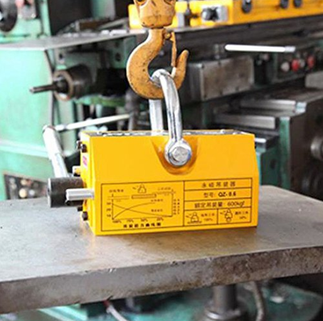
Perform a lift test at 50% of rated capacity (suspend load for 30 seconds, check for any slipping).
For electromagnetic lifters, verify cable insulation and plug connection.
Annual calibration: measure actual pull force using a calibrated dynamometer. If measured breakaway force is less than 3x rated capacity (or below manufacturer specification), return the lifter for remagnetization or replacement. Neodymium lifters typically retain 90%+ of initial strength for 10-15 years under normal use, but accidental overheating (>100°C) or severe impact can cause irreversible loss.
For workshops using lifters daily, we recommend oiling the release handle pivot points every 3 months and cleaning pole faces with a non-abrasive wipe after each shift.
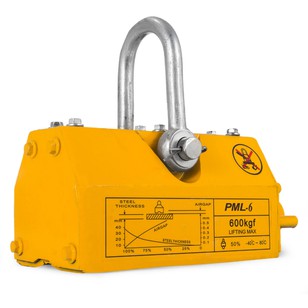
For heavy-duty magnetic lifters with capacities from 100kg to 2000kg (or custom up to 5000kg), please refer to our Magnetic Workholding & Lifting product page on our website. We supply both manual permanent lifters (no power required) and electro-permanent lifters (for remote operation).
To request a lifter sizing recommendation based on your typical load dimensions, surface condition, and crane hook height, contact our material handling team. We provide free on-site testing for large customers.
Frequently Asked Questions
Q: Can I use a 1000kg magnetic lifter to lift a 600kg plate that has a 1mm paint coating?
A: No. After derating for 1mm air gap (approx 50% reduction), your 1000kg lifter effectively handles only 500kg on painted surface. The 600kg plate is overloaded. Remove paint at contact points or use a higher-rated lifter (2000kg derated to 1000kg).
Q: How do I know if my magnetic lifter has lost strength over time?
A: Perform a pull test: attach the lifter to a clean steel plate, connect a dynamometer, and measure the force required to detach the lifter (pulling perpendicular). Compare with original breakaway force value from the test certificate. Greater than 20% loss requires service.
Q: Are magnetic lifters safe for lifting stacked plates (e.g., two 20mm plates stuck together)?
A: No. Magnetic field penetrates the top plate but does not reliably hold the second plate because of the air gap between plates. Always lift plates one at a time. Use a dedicated plate separator magnet to separate stuck plates before lifting.


