What is a Halbach Array and How Does it Concentrate Magnetic Fields?
A Halbach array rotates the magnetization direction of each magnet segment incrementally. For a linear array, the typical sequence: magnet 1 magnetized upward (north facing the work gap), magnet 2 magnetized forward (along the array length), magnet 3 magnetized downward (south facing the gap), magnet 4 magnetized backward. This 4-segment pattern repeats. The result: magnetic flux on the active side (gap) is reinforced, while flux on the opposite side (back iron) nearly cancels. The ratio of gap flux to back flux can reach 20:1, eliminating the need for heavy and costly iron yokes.
For a linear motor application (e.g., precision positioning stage), a Halbach array on the mover (slider) produces a strong magnetic field that interacts with coils on the stator. With no back iron on the mover, moving mass is reduced by 30-50%. Halbach-equipped linear motors achieve thrust densities 1.5x that of conventional permanent magnet linear motors.
Linear vs. Circular Halbach Arrays in Motor Engineering
Linear Halbach arrays are used in flat linear motors, magnetic levitation tracks, and magnetic fluid seals. The array length is limited only by the number of segments. For long travel applications (e.g., conveyor system with 10m stroke), we produce Halbach arrays in modular sections of 200-500mm each, with precise alignment dowels between sections.
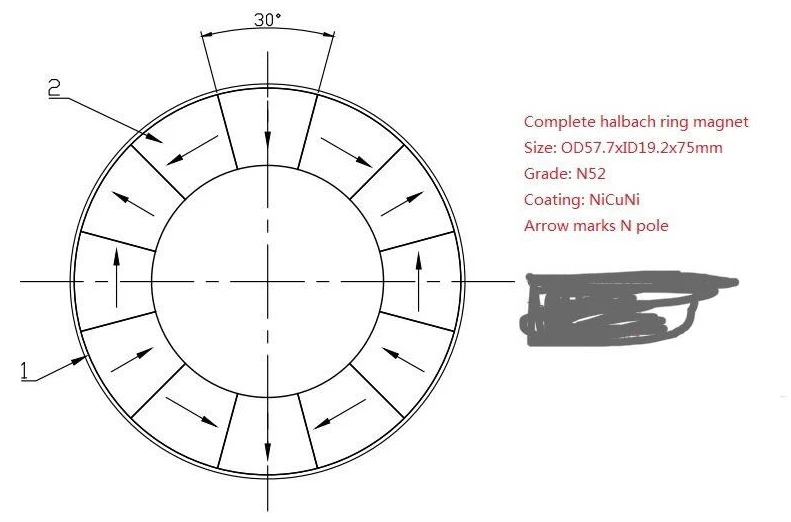
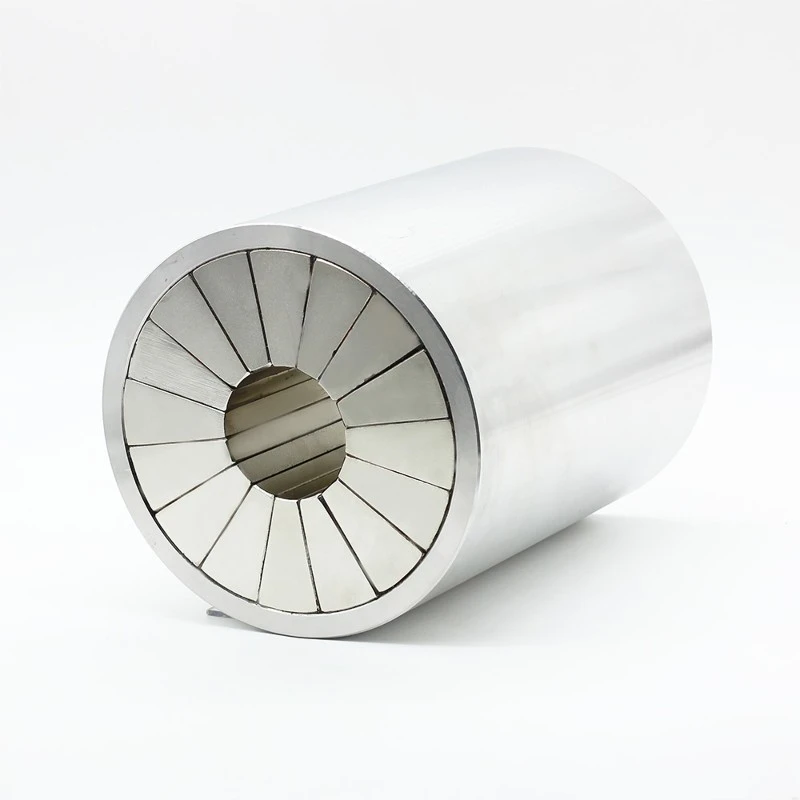
Circular Halbach arrays (also called Halbach rotors) are used in brushless DC motors, reaction wheels, and flywheel energy storage. In a circular Halbach array, the magnetization rotates continuously around the circumference. The internal field can be very uniform, suitable for MRI gradient coils or high-precision gyroscopes. However, manufacturing a circular Halbach array requires segmented arc magnets, each with a specific magnetization angle.
Comparison data:
| Configuration | Peak Gap Flux Density (Tesla) | Back Iron Required? | Typical Applications | Manufacturing Complexity |
|---|---|---|---|---|
| Conventional alternating poles | 0.9-1.1 | Yes (10-20mm thick) | General linear motors, conveyor movers | Low |
| Linear Halbach array | 1.3-1.5 (air gap 5mm) | No (or <3mm shielding) | High-acceleration stages, pick-and-place robots | Medium |
| Circular Halbach array | Internal: 1.2-1.4 | No (self-shielding) | Inner-rotor BLDC, reaction wheels, MRI | High |
| Hybrid array (with iron poles) | 1.6-1.8 | Minimal (1-2mm) | Ultra-high force density, limited stroke | High |
Manufacturing Challenges: Assembly, Gluing, and Safety Protocols
Assembling a Halbach array with neodymium magnets (N42SH or higher) is inherently dangerous due to strong and complex forces between adjacent magnets. One misplaced magnet can snap into place at speeds exceeding 5 m/s, causing finger crushing or magnet fracture.
Our manufacturing protocol:
Use aluminum or 3D-printed non-magnetic assembly fixture.
Magnets are installed one-by-one in sequence, each secured with temporary plastic shims.
Two-part epoxy (LOCTITE Hysol 9460, shear strength 25 MPa) is applied between magnets.
The entire array is pressed at 0.5-1.0 MPa pressure during epoxy cure (24 hours at 25°C).
For large arrays (>50 magnets), use staged assembly: build 5-10 magnet sub-assemblies, then join them.
We also offer Halbach arrays encapsulated in aluminum housing or stainless steel tube. Encapsulation protects magnets from corrosion and prevents accidental contact with the array's strong stray field.
For linear motor manufacturers seeking high-force Halbach arrays with precise magnetization angles (±1 degree tolerance), please visit our Magnetic Motor Assemblies category page on our website.
To request FEA simulation of a Halbach array for your linear motor – including air gap flux profile, thrust per ampere, and back iron optimization – contact our magnet engineering team.
Frequently Asked Questions
Q: Can I use off-the-shelf block magnets to build my own Halbach array in-house?
A: Not recommended. Standard blocks have fixed magnetization direction through thickness. DIY Halbach requires custom magnets with magnetization at specific angles (e.g., 0°, 45°, 90°, 135°). We supply precisely oriented magnets.
Q: What is the maximum length of a single Halbach array you can manufacture?
A: 500mm continuous length in a single housing. For longer arrays, we supply modular sections with alignment pins and magnetic coupling to ensure flux continuity. Section joint gap < 0.2mm.
Q: Do Halbach arrays require a special coating for corrosion protection?
A: Since Halbach arrays are often exposed (no back iron or housing), we recommend Ni-Cu-Ni coating (20-25μm) plus epoxy topcoat for moisture resistance. Encapsulated arrays use potting grade epoxy (1-2mm thickness).