conferences, trade shows, and hospitality because they are damage-free (no holes in clothing), easy to use one-handed, and have a more professional appearance. A typical set consists of a magnetic front badge holder (with a strong magnet) and a backplate (or "keeper") that sits behind the clothing. The magnet holds through fabric thickness. This guide covers the shift from pin fasteners to damage-free magnetic badges, 2-magnet vs. 3-magnet configurations for heavy fabrics, adhesive backing types (3M tape) and peel-strength, and packaging and logistics for bulk event orders.
Pin-back badges puncture fabric, leaving visible holes. For high-end suits, silk blouses, or uniforms, this is unacceptable. Magnetic fasteners provide:
No damage to clothing (no holes, no marks).
Quick application and removal (one-handed operation).
Higher holding force for heavy badges (e.g., large acrylic nameplates, VIP badges with RFID electronics).
Ability to reposition badge for optimal visibility (not fixed by pin holes).
The magnet holder is typically placed inside the badge (bonded or overmolded) or is a separate magnetic mount that clips onto the badge. The backplate is a steel disc or a flat magnet (opposite polarity) that sits behind the shirt, blouse, or jacket.
2-Magnet vs. 3-Magnet Configurations for Heavy Fabrics
The holding force depends on fabric thickness. A 2-magnet configuration (one magnet in the front badge, one magnet or steel plate in the back) works for thin fabrics (shirts, blouses, microfiber, up to 1.5mm thickness). For heavy fabrics (suits, coats, denim jackets, 2-4mm thickness) or oversized badges (>100g weight), we recommend a 3-magnet configuration: two magnets in the front (or one larger magnet) and a steel backplate.
| Configuration | Magnet Diameter | Magnet Thickness | Fabric Thickness | Holding Force (typical) | Best Use |
|---|---|---|---|---|---|
| 2-magnet (front + back) | 10mm | 2mm | <1.5mm | 500-800g | Shirts, light blouses |
| 2-magnet (front + back) | 15mm | 3mm | <2.5mm | 1,200-1,800g | Polo shirts, thin jackets |
| 3-magnet (2 front, 1 backplate) | 10mm each | 3mm each | <4.0mm | 2,000-3,000g | Suits, heavy coats, winter wear |
| 4-magnet (2 front, 2 back) | 12mm | 2.5mm | <3.5mm | 2,500-3,500g | Safety vests, thick uniforms |
The backplate can be a steel disc (low cost, holds well) or a second magnet (polarity aligned to attract the front magnet). A steel backplate is cheaper and sufficient for most applications. A magnet backplate provides higher holding force for the same size but requires proper polarity alignment (magnetized after assembly).
Adhesive Backing Types (3M Tape) and Peel-Strength
For custom badge fasteners, the magnet front holder is often attached to the badge using an adhesive backing. 3M VHB (Very High Bond) tape is the standard:
3M 9495 (double-sided acrylic tape): Peel strength 2.5-3.5 N/mm², temperature range -40°C to 149°C. Suitable for metal, plastic, and acrylic badges. Cures in 24 hours (72 hours for full strength).
3M 300LSE (high-tack for low surface energy plastics): For polypropylene, polyethylene, or textured surfaces. Peel strength 3.0-4.0 N/mm².
Foam tape (e.g., 3M 4941): For uneven badge surfaces. Compressible, absorbs stress. Lower peel strength (1.5-2.5 N/mm²) but better gap filling.
For bulk orders, we apply the 3M tape pre-installed on the magnet holder. The badge assembly is then pressed onto the tape. This eliminates the need for the customer to apply adhesive. The tape's peel strength should exceed the magnetic holding force by at least 2x: if the magnet holds 1,000g, the tape should withstand 2,000g shear force to prevent the badge from sliding off the magnet.
Event orders are often large (500-5,000+ sets) and require specific packaging:
Each magnet set (front holder + backplate) packaged in a poly bag to prevent magnet-to-magnet attraction during shipping.
50 or 100 sets per inner carton.
Outer cartons labeled with quantity, polarity (for backplate magnets), and adhesive type.
For overseas shipping, magnets must be packaged with iron shielding or with sufficient spacing to meet IATA magnetic material regulations (UN2807). For most badge magnets (small size), the field at the outer package surface is <0.00525 gauss, qualifying as non-regulated. We supply each package with a magnetic field measurement certificate.
We offer custom branding options: the magnet holder can be overmolded with your company logo or supplied in custom colors (black, white, or Pantone-matched colors). For VIP events, we supply gold or silver-plated magnetic fasteners.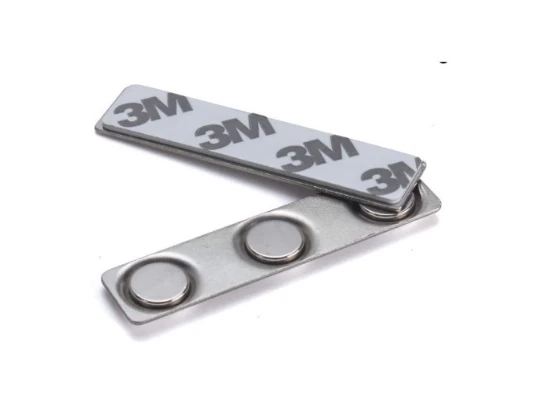
Frequently Asked Questions
Q: Do magnetic name badges affect pacemakers or medical devices?
A: Yes, strong magnets can interfere with pacemakers. We recommend a warning label: "Keep magnet at least 150mm (6 inches) from pacemakers." For corporate events with medical staff, we provide low-field ferrite-based fasteners (<1,000 Gs surface field) as a safer alternative.
Q: Can I use magnetic badges on silk or other delicate fabrics without damaging?
A: Yes. Use a magnet with a soft plastic or rubber coating (or place a small felt disc between the backplate and fabric). The fabric is not pierced or pinched. For ultra-delicate fabrics (silk chiffon), use the smallest possible magnet (6-8mm diameter) to minimize pressure on the fabric.
Q: How many times can the 3M VHB tape be repositioned during assembly?
A: Once pressed, the tape is permanent and cannot be repositioned without damaging the tape. Use a jig or template to position the magnet correctly on the badge before pressing. We offer custom jigs for large orders to ensure consistent positioning.