
Three Consumer Electronics Applications Where Magnet Spec Determines Product Success
Consumer electronics is not where most magnet engineers expect to find their hardest problems. Industrial servo motors have tighter tolerances, medical devices have stricter material requirements, and aerospace applications have more severe environments. But consumer electronics - specifically smartphones, wearables, and audio devices - imposes constraints that don't appear in any of those other categories: extreme volume sensitivity, millimeter-scale form factor, and end-product price points where the entire magnet budget is measured in cents per unit.
This article focuses on three specific applications where magnet specification and sourcing decisions have direct, measurable consequences for product performance: OIS camera actuators in smartphones, linear resonant actuators (LRA) in haptic feedback systems, and voice coil motors in TWS earphone drivers. Each has different dominant constraints, and the correct approach for one is wrong for the others.
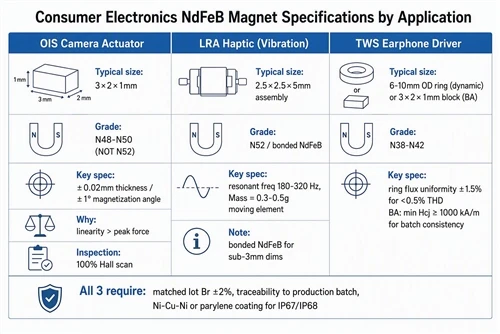
1. OIS Camera Actuators: Why N52 Is Not Always the Answer
Optical image stabilization in smartphone cameras uses a voice coil motor (VCM) to shift the lens element or image sensor laterally, compensating for hand tremor during capture. The driving magnets are typically four discrete pieces arranged around the lens barrel - two opposing pairs, each providing a restoring force to the moving element. The air gap between magnet and coil is 0.3–0.5mm in most designs. The moving mass being stabilized is 0.5–2g for lens-shift OIS and 2–5g for sensor-shift OIS.
The temptation is to specify the highest available grade (N52 or N52H) to maximize flux density and therefore actuator force in the limited air gap. This is wrong for most OIS designs for a specific reason: OIS actuator performance is limited not by peak force but by linearity and hysteresis across the operating stroke. A higher-grade magnet produces more force, but it also produces a stronger position-dependent detent force when the Hall effect position sensor's resolution interacts with the magnet edge field. For closed-loop OIS controllers, what matters is the linearity of force-vs-displacement across ±100–200μm, not peak force. N48 or N50 with tightly controlled edge geometry typically outperforms N52 on this metric because the lower gradient at the operating point is more linear.
Dimensional tolerance for OIS magnets is severe. A typical OIS magnet block is 3mm × 2mm × 1mm. Thickness tolerance of ±0.02mm (20μm) is standard. Angular alignment of the magnetization direction must be within ±1° of the specified axis, because OIS coil winding patterns are designed for a specific flux angle and lateral misalignment produces cross-axis coupling that degrades stabilization quality. Incoming inspection must include both dimensional check and magnetization angle verification - visual inspection alone misses the most common defect mode.
2. Linear Resonant Actuators: The Mass-Spring Optimization Nobody Explains
LRA haptic actuators - used in smartphone vibration alerts, gaming controllers, and wearable devices - operate on a fundamentally different principle from OIS actuators. An LRA drives a moving mass (the magnet assembly or a ferromagnetic target, depending on design) against a spring at the resonant frequency of the mass-spring system. Maximum output vibration intensity occurs exactly at resonance; operating 5Hz off resonance reduces output by 30–50% depending on the Q factor of the suspension.
The magnet's role in an LRA is to provide the driving force for the coil-magnet interaction, but also to be part of the moving mass. For a fixed spring constant and target resonant frequency, increasing magnet size and mass shifts the resonant frequency downward (f = (1/2π) × √(k/m)). In a 2.5mm × 2.5mm × 5mm LRA format - common in wearable devices - the magnet assembly mass is typically 0.3–0.5g and the target resonant frequency is 180–230 Hz for the low-frequency "thud" haptic profile, or 280–320 Hz for the sharp "click" profile used in trackpads and buttons.
Grade selection for LRA magnets is primarily driven by force density, not temperature performance. LRA magnets operate at 20–60°C in normal use and spend most of their life at ambient temperature. N52 is genuinely the correct choice here - the application is volume-limited and force-density-limited, not temperature-limited. The constraint is that N52 at small dimensions requires resin-bonded or thin-slab sintered NdFeB, both of which have different magnetization curve characteristics than standard block sintered NdFeB. Bonded NdFeB has BHmax of 8–12 MGOe vs. 52 MGOe for sintered - a factor of 4–6 reduction in energy product. For LRA magnets below 3mm in any dimension, bonded NdFeB is often chosen for manufacturability despite the energy product penalty, because sintered NdFeB cannot be reliably produced and magnetized at those dimensions without significant yield loss.
3. TWS Earphone Drivers: Where Magnet Distortion Becomes Audible
Balanced armature and dynamic driver earphones both rely on magnets, but the specification requirements are different enough that they're essentially separate product categories from a sourcing perspective.
Dynamic drivers use a ring-shaped NdFeB magnet (typically 5–10mm OD, 2–4mm ID, 1–2mm thick) to create a radial flux field in a cylindrical air gap where the voice coil sits. The output sound pressure level, frequency response, and distortion characteristics of the driver are all functions of the magnet's B-H operating point, the gap field uniformity, and the consistency of the magnetization. For consumer TWS earphones in the $20–80 price range, N38–N42 grade in standard Ni-Cu-Ni coating is the industry norm - cost-effective and adequate for the operating temperature range (maximum 60°C in ear).
The performance-limiting failure mode for dynamic driver earphones is not magnet demagnetization (which is essentially impossible at operating conditions for N38 or higher) - it's magnet non-uniformity causing asymmetric flux distribution in the air gap. An asymmetric gap field produces second-harmonic distortion in the driver output that is audible as a "rough" or "grainy" character in the low-frequency response. The specification that controls this is flux uniformity around the ring, measured as the variation in Br around the OD of the ring at constant height. For earphones targeting below 0.5% THD at 100dB SPL, ring flux uniformity better than ±1.5% is required. Standard production NdFeB rings typically achieve ±2–3%; achieving ±1.5% requires process control on the magnetization fixture and 100% flux scan inspection at the ring level.
Balanced armature drivers use a different geometry - a small rectangular magnet (typically 3mm × 2mm × 1mm or smaller) as part of a magnetic circuit that includes a permalloy armature. The magnet in a BA driver must have consistent coercivity lot-to-lot because the armature polarization is affected by the operating point, and driver sensitivity shifts if the magnet grade varies between production batches. For BA drivers, specifying minimum Hcj (intrinsic coercivity) in addition to Br is essential - standard N35 spec has Hcj ≥ 955 kA/m, but requesting a tighter minimum of 1000 kA/m improves batch-to-batch consistency in the assembled driver.
4. Sourcing Considerations: Why Consumer Electronics Magnets Are Different to Buy
The three applications above all require magnets that are physically small, dimensionally precise, and produced in high volumes. This creates a sourcing situation that differs from industrial or EV magnet purchasing in several important ways.
First, the unit economics require blanket orders and Kanban delivery rather than project-by-project purchasing. A smartphone OIS magnet used in 100,000 handsets per month is four magnets per phone, or 400,000 pieces per month. At $0.05–0.15 per piece, this is a $20,000–60,000 per month line item. The magnets must arrive in matched lots (consistent Br within ±2% across a lot) to avoid production line variation. Purchasing from spot market or mixed-lot inventory is not acceptable; traceability to production batch is required for line yields to be predictable.
Second, coating requirements for consumer electronics magnets are different from industrial. NdFeB in a sealed smartphone module sees condensation cycles during temperature testing (–40°C to +85°C per the consumer electronics environmental spec) in high-humidity environments. Standard Ni-Cu-Ni coating passes this requirement for most modules. However, OIS magnets in waterproof phones (IP67/IP68) benefit from parylene conformal coating over the Ni-Cu-Ni, which provides corrosion resistance in the direct water exposure scenario without affecting the dimensional tolerance.
HIMAGNET produces small-format NdFeB magnets for OIS, LRA, and earphone driver applications in grades from N38 to N52, including ring, block, and arc geometries below 10mm in all dimensions. Tight-tolerance grinding to ±0.01mm and 100% flux scan inspection are available for OIS and BA driver applications. Contact us with your geometry, grade, and monthly volume for a DFM review and pricing.


