NdFeB Magnet Flux Stabilization: Why Freshly Magnetized Parts Need Aging Before Use
NdFeB magnets can show a small but measurable change in flux after magnetization. For applications that require repeatable force, torque, or sensor output, freshly magnetized parts should be stabilized before they are assembled or released.
What happens after magnetization?
Magnetization drives the material into a defined magnetic state, but some domains can relax during the first hours and days. The resulting post-magnetization irreversible flux loss is influenced by grade, operating point, temperature, geometry, and the magnetic circuit. High-energy grades and parts operating near a knee of the demagnetization curve deserve particular attention.
Without a controlled aging step, production measurements may not represent the flux that the customer sees in service. A stabilization treatment intentionally brings the initial change forward and makes the remaining drift smaller and more predictable.
Thermal stabilization parameters
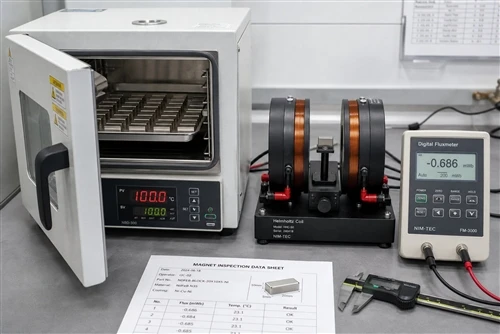
A thermal soak accelerates the same relaxation mechanisms that would otherwise occur slowly at room temperature or in service. The selected temperature must remain below the coating limit and below any application-specific demagnetization risk. Common engineering starting points are 80–180°C, with the exact set point and duration qualified for the grade and assembly.
- N35–N45: 100°C for 2 hours is a common starting point.
- N48–N52: 100°C for 2 hours, with load-line verification and production validation.
- N45H–N52H: 120°C for 3 hours may be used when the higher-temperature grade and coating permit it.
Use a controlled ramp, uniform part temperature, and a soak timer that starts only after the load reaches the target temperature. Record atmosphere, fixture, batch size, and coating limitations.
How to measure effectiveness
Measure representative samples before treatment and after cooling to a defined reference temperature. Compare flux or magnetic moment using the same fixture, pole geometry, instrument, and orientation. For critical applications, monitor residual drift at the intended service temperature, for example with a 1000-hour test at 80°C. The acceptance limit should distinguish the controlled upfront loss from the remaining service-life drift.
How to specify stabilization on a purchase order
State the magnet grade, stabilization temperature, soak time, ramp and cooling requirements, coating compatibility, measurement method, and allowable residual drift. Also identify whether the requirement applies to loose magnets or the completed magnetic assembly. A clear purchase-order statement prevents a nominal grade specification from being interpreted as a long-term stability guarantee.
Practical takeaway
Magnet aging is not a substitute for correct grade selection or magnetic-circuit design. It is a production-control step that makes post-magnetization flux loss measurable, repeatable, and easier to manage. HIMAGNET can help define a stabilization window and verification plan for your NdFeB application.